Eco-Friendly Hotel Amenities: Materials, Cost and What Hotel Groups Now Ask For
Sustainability requests have moved from the marketing department to the procurement questionnaire. The problem is that 'eco-friendly' describes a claim, not a specification — and the two are frequently far apart.
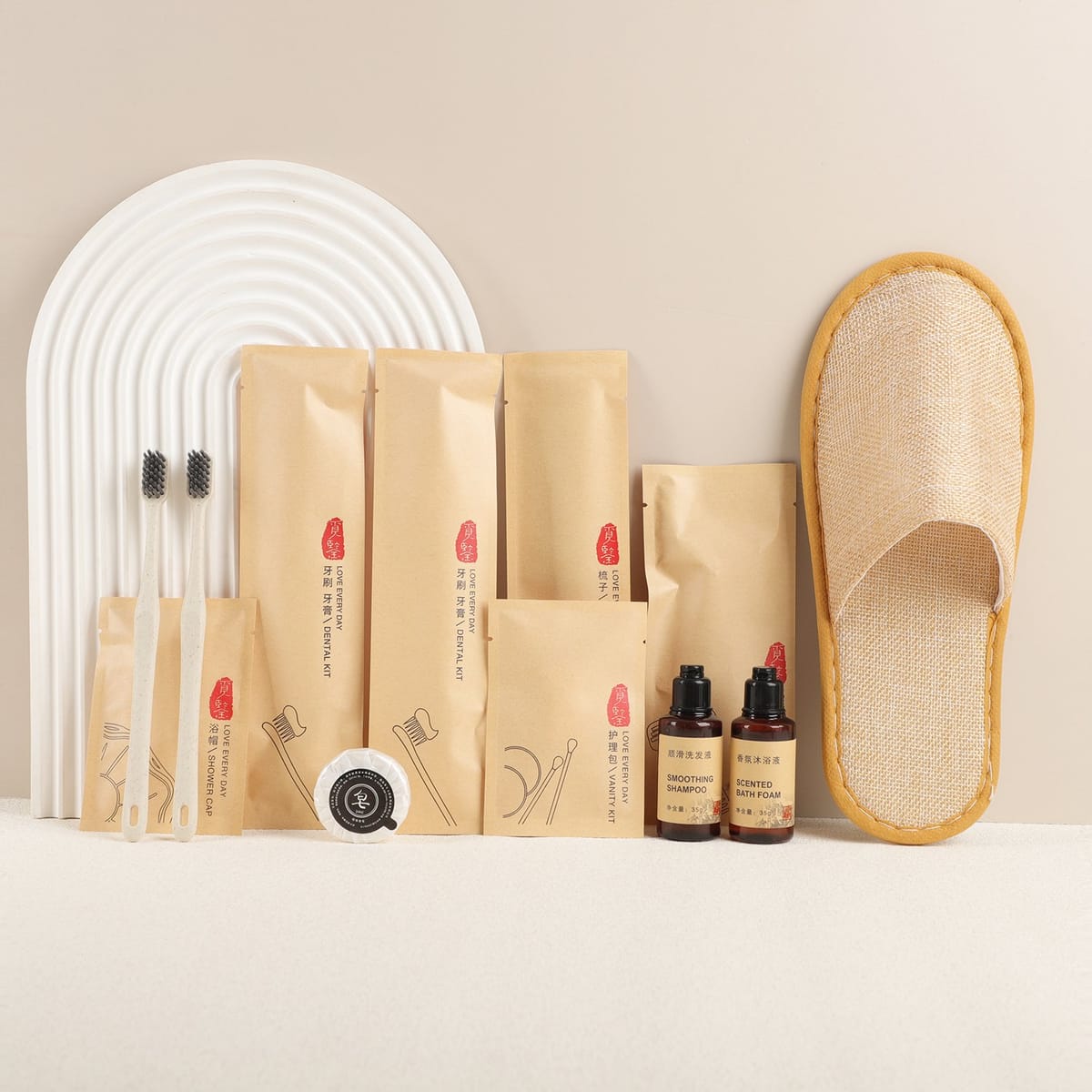
Hotel groups now ask suppliers to document material composition, recyclability and packaging format, and several markets have introduced restrictions on single-use plastic guest items. Meanwhile the number of products marketed as 'biodegradable' has grown faster than any credible standard behind the word. This guide covers what actually reduces environmental impact in an amenity programme, what it costs, and how to describe it without exposing yourself to a greenwashing complaint.
1. Where the impact actually sits
In a typical room-set, most of the mass and most of the waste is packaging, not product. A 5g sachet of shampoo arrives in a laminated foil pouch that is effectively unrecyclable; a 20g soap bar arrives wrapped in a plastic film. Before buying 'eco' products, look at your waste audit — the biggest win is usually the cheapest one.
| Component | Conventional | Lower-impact option | Cost direction |
|---|---|---|---|
| Toothbrush handle | Virgin PS / PP | Wheat straw or bamboo | Slightly higher |
| Comb | Virgin PS | Wheat straw | Slightly higher |
| Pouch | Laminated foil or OPP | Kraft paper or uncoated paper | Higher |
| Bottle | Virgin PET | rPET or bio-PE (sugarcane) | Highest |
| Slipper upper | Virgin polyester fleece | Recycled PET fleece or cotton | Slightly higher |
| Soap wrap | PVC / OPP film | Pleated paper wrap | Modest |
| Bath products | Single-use 30ml bottles | Refillable dispensers (fixed) | Capital outlay, then lower |
2. The materials that hold up to scrutiny
Wheat straw and bamboo accessories
Wheat straw composite (PP with 30-50% agricultural residue) and bamboo handles both look convincing to guests and can be documented by material. Bamboo is genuinely a fast-renewing resource; wheat straw reuses a waste stream. Neither is home-compostable in practice — they are lower-impact rather than zero-impact, and describing them accurately matters more than the label.
Kraft and uncoated paper packaging
A straightforward kraft pouch removes the plastic laminate from the waste stream and usually reads as premium. The trade-off is moisture sensitivity for liquid products — for gels and creams you generally need an inner barrier or a coated board, which reduces the benefit. Ask what the actual construction is, layer by layer.
rPET and bio-PE bottles
Recycled PET (rPET) is the most verifiable bottle option, with documented recycled content percentage. Bio-PE from sugarcane is bio-based but not biodegradable — a distinction many suppliers blur in their brochures. If your hotel group requires a specific recycled content figure, ask for the material certificate rather than a marketing sheet.
Refillable dispensers
Fixed dispensers in the shower are the single largest reduction available: they remove the bottle entirely for the majority of room-nights. They require a capital purchase, housekeeping discipline and a decision about tamper-evident locking. In markets where single-use toiletry bottles are restricted, they are no longer optional.
3. What regulation is actually driving this
The EU Single-Use Plastics Directive targets specific items — cutlery, plates, straws, cotton bud sticks, balloon sticks and certain food containers — rather than hotel toiletries as a category. However, several member states have gone further with national rules on single-use plastic in hospitality, and France in particular has restricted single-use plastic toiletry bottles in hotels. Because national implementation varies, the practical answer is: check the rules for each market you operate in, and design for the strictest one you serve.
4. What it costs
Lower-impact specifications always cost more than conventional ones, and the increment is largest on bottles and packaging — the very items where the environmental gain is also largest. Two things soften it: at container volumes the gap narrows noticeably, and reduced packaging volume often lowers freight enough to offset part of the material cost.
The better way to frame the decision is cost per occupied room rather than unit price. Calculate the additional cost per room-set with your own quoted figures, multiply by annual occupied room-nights, and compare it with what a documented sustainability position is worth in your corporate and MICE segments. Framed that way, the decision is usually about positioning rather than budget — but it should still be calculated, not assumed.
5. How to describe it without greenwashing
- 1Describe the material and the percentage, not the adjective: 'bamboo handle' beats 'eco-friendly toothbrush'.
- 2Do not say 'biodegradable' unless you can name the standard and the test condition. Most guest items do not degrade in landfill conditions.
- 3Avoid 'plastic-free' when the pouch has a barrier layer or the cap is PP.
- 4Keep the claim inside your own control — if your supplier cannot document it, you cannot advertise it.
- 5Publish what you are still working on. Buyers and auditors trust a programme with stated limits far more than a page of absolutes.
6. A realistic starting sequence
- 1Switch packaging first: kraft pouch for dry items, paper wrap for soap. Cheapest visible change.
- 2Move high-volume accessories (toothbrush, comb) to wheat straw or bamboo.
- 3Consolidate bottles to dispenser or larger refill format where regulation and guest profile allow.
- 4Move slipper fleece to recycled PET, keeping weight and colour constant so guests notice no difference.
- 5Document everything per SKU, so the sustainability page on your website is supported by supplier evidence.
Our eco kraft amenity series and wheat straw series show what these specifications look like assembled. If you already have a sustainability questionnaire from a hotel group, send it over and we will tell you which lines we can document and which we cannot — see contact.
Frequently Asked Questions
Are bamboo toothbrushes actually biodegradable?+
The handle is, in industrial composting conditions; the bristles are usually nylon and are not. Say 'bamboo handle' rather than 'biodegradable toothbrush' and you remain accurate.
How much more do eco amenities cost?+
They cost more than conventional specifications, with the largest increment on bottles and packaging and the smallest on paper wrap and packaging swaps. The premium narrows at container volumes. Ask for two quotations against the same specification — one conventional, one lower-impact — and you can compare the difference per room-set directly.
Need this specification quoted for your property?
Send your room count, star rating and target unit price. We reply with a costed specification, not a catalogue page — usually within 12 hours.
Continue reading
Buying Guides
Hotel Slippers Wholesale: The Complete Buying Guide for Hotels and Distributors
How to specify hotel slippers wholesale: closed vs open toe, coral fleece and linen, sole thickness, MOQ, packaging and the sample checklist.
Wholesale Pricing
Hotel Amenities Wholesale Quotes Explained: Why Two Suppliers Price the Same Kit Differently
Why hotel amenities quotes differ: the six variables behind every price — material, fill volume, packaging, printing, quantity and freight.