How to Choose a Hotel Amenities Supplier in China: A 10-Point Buyer's Checklist
Most sourcing problems are not caused by a bad factory. They are caused by a buyer choosing a supplier using criteria that do not predict delivery performance — price, a glossy catalogue and a fast reply.
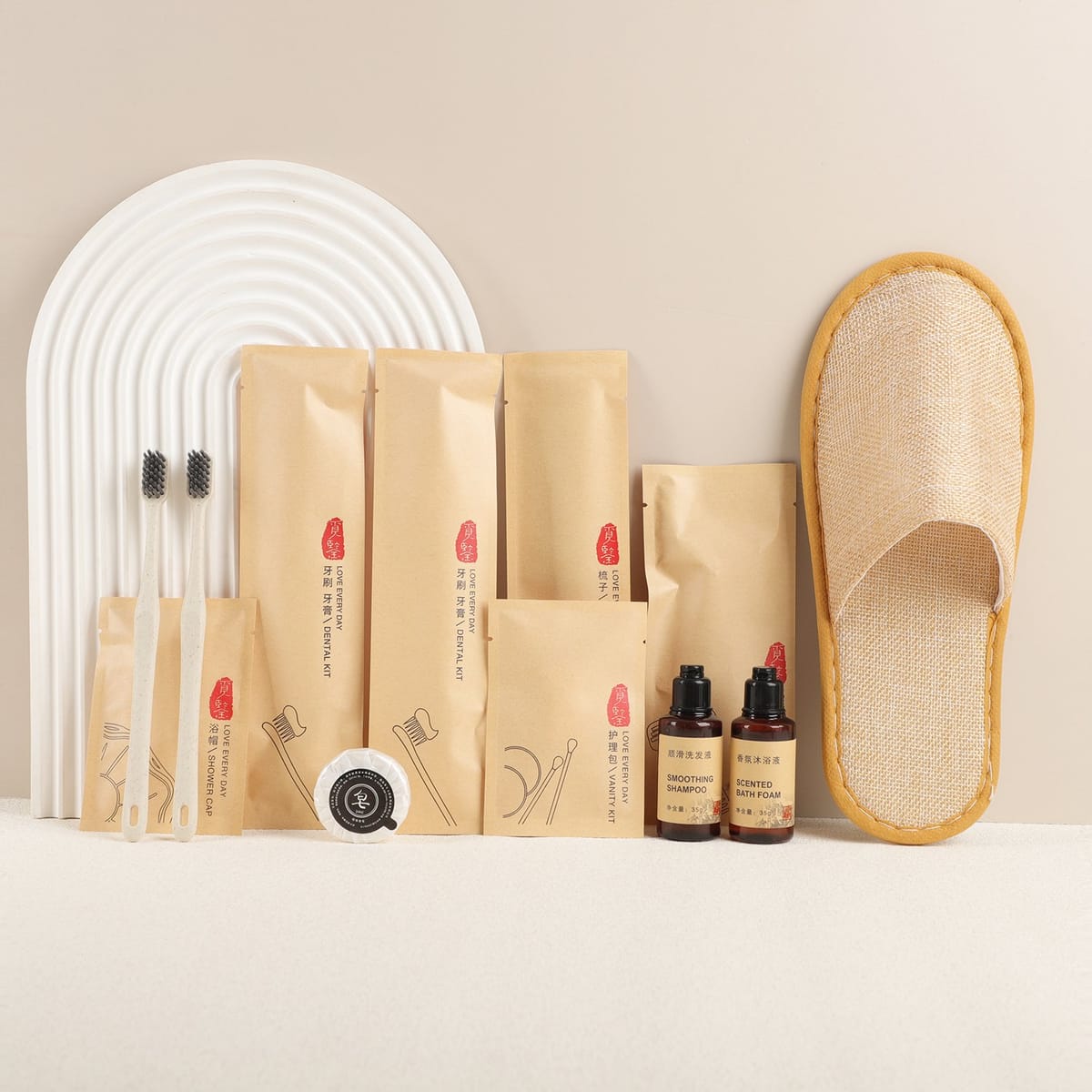
Hotel amenity programmes are unforgiving: a container that arrives three weeks late leaves rooms without slippers, and a colour that does not match the previous batch is visible in every guest photo. The evaluation framework below is the one we would use ourselves if we were buying, and we have written it so that any supplier — including us — can be measured against it.
1. Establish what kind of company you are talking to
There are three common profiles in this industry, and they behave very differently when something goes wrong:
| Profile | What it looks like | Risk |
|---|---|---|
| Manufacturer | Owns production lines for its core items; subcontracts peripheral items | Lowest, if the core items are what you buy |
| Trading company | Coordinates several factories; no lines of its own | Depends entirely on supplier management discipline |
| Platform reseller | Lists thousands of SKUs, holds no stock | High: specification control is usually weakest |
None of these is automatically disqualifying. A well-run trading company can be more reliable than a small factory, because it manages several production sites. What matters is that the supplier is honest about which it is — a company that claims to manufacture everything from slippers to soap to bedding in-house is almost certainly describing a supply network.
2. Ask for the specification in writing before the price
A serious supplier will send a specification sheet — material, weight, dimensions, fill volume, packaging, carton count — before or alongside the quotation. If the first reply is a price with a photo attached, you have learned something useful. Written specifications are also your only protection at inspection time.
3. Verify the factory, not just the showroom
- 1Request a short video call walking through the production area, not a photo gallery.
- 2Ask which processes are in-house and which are subcontracted — then ask for the subcontractor's name.
- 3Check the business licence and confirm the legal entity name matches the bank account on the invoice.
- 4If the order value justifies it, book a third-party inspection (SGS, Bureau Veritas, TÜV, Intertek) for the first shipment.
4. Documents to request (and what they do not prove)
- Specification sheet per SKU — the baseline for any quality claim.
- Material safety data sheets (MSDS) for liquids and gels, needed for shipping and customs.
- Third-party test reports for the specific product and material, with a report date less than 12 months old.
- Factory audit reports, if the supplier holds them — check the scope and the date, not just the logo.
- Batch and production date coding on the packaging, which matters for cosmetics shelf life and traceability.
5. Test the sample process, because it predicts production
The sample stage is a compressed version of the whole relationship. Watch for these signals:
- Do they confirm your specification back to you in writing before sampling, or just say 'ok'?
- Is the sample timeline stated and then met? A 5-7 day sample that arrives in 16 days is a preview of production.
- Do they flag problems — a colour that cannot be matched, a fill volume that needs a different bottle — or stay silent and ship something close?
- Is the sample labelled with the specification it represents? Unlabelled samples cannot be used as a quality reference later.
6. Ask about reorder consistency
This is the question most buyers forget, and it is where amenity programmes quietly fail. Ask: how long do you keep my artwork and material records; what is the minimum reorder quantity in the same colour; and what happens if my fabric is discontinued? A supplier that stores approved samples and printing files can repeat an order a year later. One that cannot will send you a 'similar' product and call it the same.
7. Payment terms tell you about their cash position
30% deposit with 70% against the bill of lading is the regional norm, and it is reasonable. Be cautious with suppliers who demand 100% upfront, and equally cautious with those who accept no deposit at all — that usually means they are financing production on someone else's money and cannot absorb a problem. For larger orders, a letter of credit protects both sides.
8. Red flags worth taking seriously
- Prices far below the market floor with no explanation of what was removed.
- Refusal to put specifications or inspection criteria in the contract.
- A different company name on the proforma invoice than on the quotation.
- Instant agreement to every request, including ones that are technically impossible.
- No physical address, or an address that does not match the business licence.
9. Structure the first order as a test
Start with one or two SKUs at a modest volume rather than a full room-set container. You are testing four things: specification accuracy, packaging quality, documentation completeness and communication speed. If all four hold, the second order can be the full programme. If one fails, you have lost a small amount rather than a season.
10. Judge communication, not enthusiasm
Fast replies are easy; useful replies are not. A good supplier answers with specifics: a weight, a lead time, a carton count, a limitation. Enthusiasm without detail is the most reliable warning sign in this industry.
If you would like to run this checklist against us, start with our product range, the OEM and customization process and our FAQ, then send the questions you cannot answer from those pages. We will reply in writing, with specifications.
Frequently Asked Questions
Should I buy through a trading company or directly from a factory?+
For a single product category at volume, direct is usually cheaper and more controllable. For a full room-set spanning slippers, kits, bottles and soap, a supplier with a managed network often delivers more consistently than four separate factories.
Do I need a third-party inspection?+
For any first order of meaningful value, yes. A pre-shipment inspection is inexpensive relative to the order and catches quantity, specification and packaging errors before they become your problem.
Need this specification quoted for your property?
Send your room count, star rating and target unit price. We reply with a costed specification, not a catalogue page — usually within 12 hours.
Continue reading
Wholesale Pricing
Hotel Amenities Wholesale Quotes Explained: Why Two Suppliers Price the Same Kit Differently
Why hotel amenities quotes differ: the six variables behind every price — material, fill volume, packaging, printing, quantity and freight.
OEM & Customization
Custom Hotel Amenities With Your Logo: OEM Process, Artwork and Realistic Timelines
How hotel branding on amenities works: embroidery, silk screen, hot stamping, soap embossing, artwork files, proofing, MOQ and lead times.